Many people notice the same strange pattern.
All day long, basic tasks feel exhausting.
But late at night — sometimes 10 PM, 11 PM, or even midnight — motivation suddenly appears.
You organize a drawer.
You rearrange a room.
You start deep cleaning the kitchen.
This behavior is extremely common. And surprisingly, it is not about discipline or personality.
It is largely about how the brain manages mental pressure, decision load, and circadian timing.
The Brain After Dark Works Differently
Your brain does not operate at the same level of control throughout the day.
During daytime hours, the prefrontal cortex is busy handling:
- responsibilities
- communication
- planning
- social behavior
- expectations from others
Psychologists call this cognitive load.
By nighttime, most external demands stop. No emails, no appointments, no interruptions.
This creates a rare state: low social demand but high mental wakefulness.
Your brain suddenly has unused processing capacity.
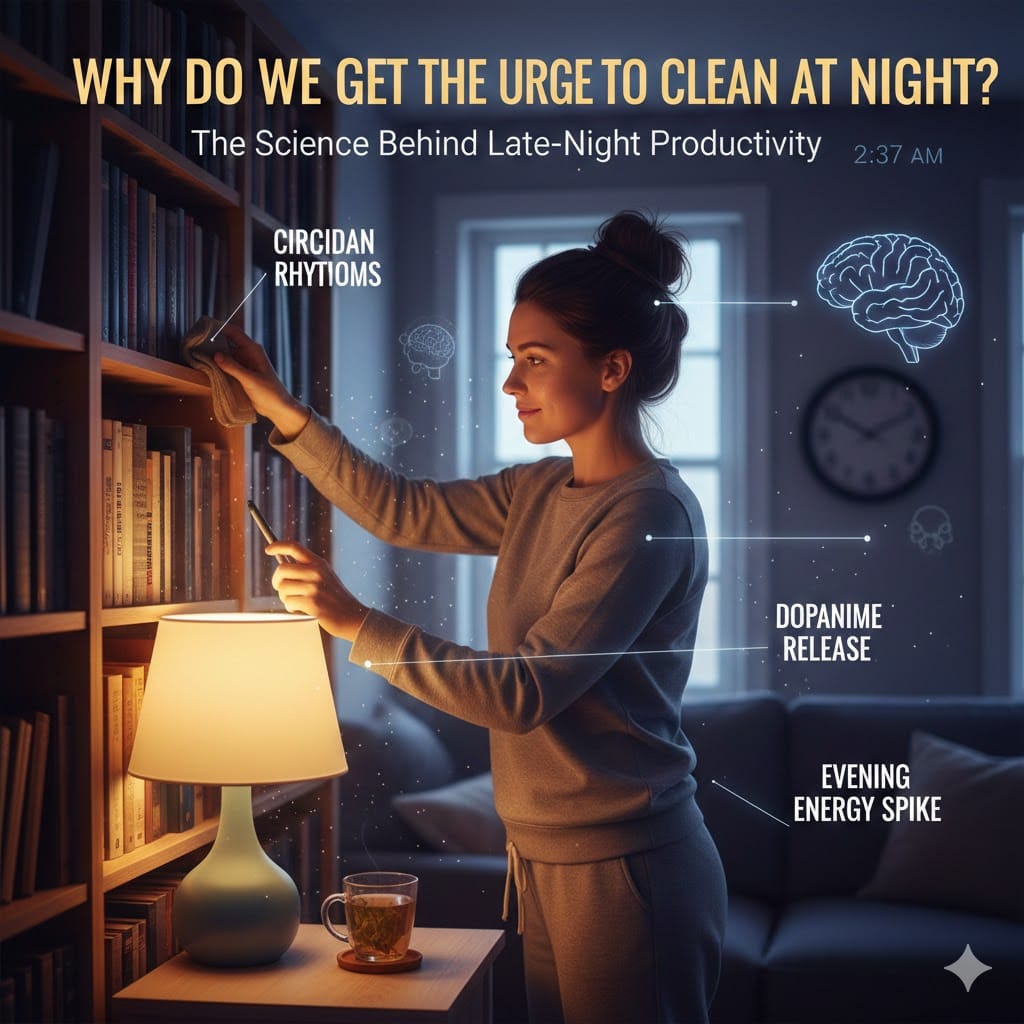
Instead of resting, many brains redirect that energy into structured tasks — and cleaning is one of the easiest structured activities available.
Cleaning Reduces Mental Noise
Cleaning is not just a physical activity.
It is a psychological regulation behavior.
Your brain constantly tracks unfinished tasks. Scientists sometimes call these open cognitive loops.
Examples:
- clothes on a chair
- dishes in the sink
- cluttered desk
- messy drawer
Even when you are not thinking about them consciously, your brain keeps registering them as incomplete.
At night, when distractions drop, your mind becomes more aware of these unfinished signals. Cleaning closes those loops.
The result is a noticeable mental relief feeling.
That relief — not the cleanliness — is what your brain is actually seeking.
Sometimes, our brains create rituals and habits without us even noticing — from arranging objects in a certain order to feeling the need to do something “just right” before bed. These subtle behaviors reveal how the mind looks for control in daily life. If you’re curious about these hidden patterns, check out The Secret World of Everyday Superstitions You Never Noticed.
The Cortisol Drop Effect
Cortisol is often called the “stress hormone,” but it actually functions as a wakefulness regulator.
Your daily cortisol cycle:
- Morning: high (helps you wake up)
- Afternoon: moderate
- Evening: decreasing
- Late night: low
When cortisol drops, your brain shifts from reactive thinking to reflective thinking.
You stop reacting to tasks and start organizing them.
That is why late at night people:
- clean
- plan life goals
- reorganize rooms
- start journaling
- rearrange furniture
Your brain moves from survival mode to control-restoration mode.
Cleaning becomes a way to re-establish order.
Decision Fatigue Makes Simple Tasks Appealing
Throughout the day you make thousands of decisions:
what to say, where to go, what to respond to, what to ignore.
By night, decision fatigue sets in.
Your brain begins preferring binary tasks — activities with clear outcomes and minimal choices.
Cleaning is perfect:
- dirty → clean
- cluttered → organized
- done → finished
Unlike work or social interactions, cleaning has immediate completion feedback.
The brain finds this deeply satisfying.
Why Night Feels More Productive
You may not actually have more energy at night.
You have fewer psychological interruptions.
Daytime includes:
- expectations
- noise
- notifications
- obligations
- performance pressure
At night, these disappear. The brain enters a state called autonomous attention — focus driven by internal motivation rather than external demand.
In this state, even small tasks feel rewarding.
The Control Restoration Theory
There is also a behavioral psychology explanation.
When people feel their day was unstructured or unpredictable, they subconsciously try to restore control before sleeping.
Cleaning and organizing are physical ways to:
- reset the environment
- prepare tomorrow
- reduce uncertainty
Your brain interprets a tidy environment as a predictable environment.
Predictability lowers background stress.
So late-night cleaning is often less about hygiene and more about psychological closure for the day.
Ever find yourself wide awake around 3 AM, staring at the ceiling and wondering why your body chose that exact hour? This common phenomenon is often linked to sleep cycles, stress, and even subtle shifts in your body’s internal clock. To dive deeper into why this happens so often, check out Why Do We Wake Up at 3 AM? (And Why It’s So Common).
Why You Rarely Want to Clean in the Morning
Morning brains are task-oriented, not reflective.
After waking up, the brain prioritizes:
- time management
- planning
- obligations
Cleaning doesn’t help immediate goals, so motivation stays low.
At night, priorities reverse:
The brain is no longer preparing for the world — it is processing the day that already happened.
That shift changes motivation.
The “Tomorrow Will Be Better” Effect
Cleaning at night has a strong anticipatory reward.
You are not just cleaning for now.
You are cleaning for future you.
Seeing an organized space in the morning creates a psychological reset. The brain expects a smoother day.
That expectation alone improves mood and perceived productivity.
So the motivation spike is actually tied to future planning, not current energy.
Is It a Problem?
No. In fact, it is a normal behavioral pattern.
The only time it becomes disruptive is when:
- it repeatedly delays sleep
- it becomes compulsive
- you feel unable to relax without cleaning
Otherwise, late-night productivity is simply your brain using quiet hours to resolve unfinished mental signals.
Why So Many People Experience It
Modern schedules are heavily structured. Many people spend the day reacting to external demands rather than acting on internal motivation.
Nighttime is often the first moment the brain feels:
- uninterrupted
- unobserved
- self-directed
Cleaning becomes a simple, controllable action that restores mental balance before sleep.
So when you suddenly feel motivated to organize your entire room at 11:30 PM, your brain isn’t being strange.
It’s finally working on its own priorities.