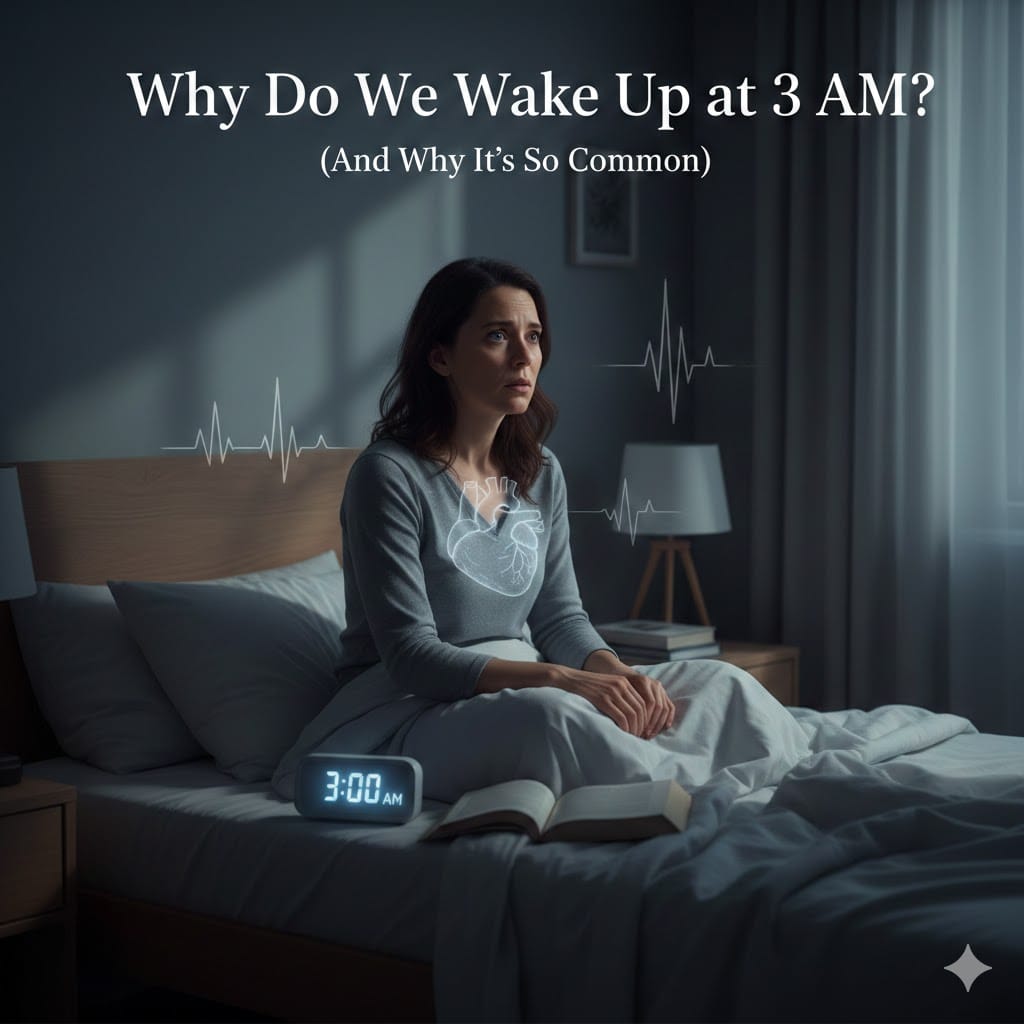
Have you ever noticed something oddly specific?
You fall asleep normally…
Then suddenly — almost every night — you wake up around 2:30 to 4:00 AM for no clear reason.
You’re not fully awake.
You’re not rested either.
And your brain immediately starts thinking.
You check the clock and there it is again: 3:07 AM.
This is one of the most searched sleep questions online — and surprisingly, it’s not random.
A very common experience
One reader described something extremely specific:
every night he would wake up, convinced he heard a noise somewhere in the house. He would check the hallway, the kitchen, even the door — nothing.
After a few weeks he realized something odd: it was always around the same time, between 2:50 and 3:20 AM.
He thought it was anxiety.
He thought it was insomnia.
It was neither.
What he was experiencing was simply the moment his brain exited a deep sleep phase and briefly switched into alert mode. Because the environment was quiet and dark, his mind searched for a reason to justify being awake — and interpreted normal house sounds (air ducts, fridge compressor, wood contraction) as something meaningful.
First: Your Body Actually Runs on Timed Cycles
Sleep is not a single block of unconsciousness.
Your brain follows what neuroscientists call sleep architecture, composed of repeating 90-minute cycles:
- Light sleep (Stage N1)
- True sleep (Stage N2)
- Deep sleep (Stage N3)
- REM sleep (dream sleep)
These cycles repeat 4 to 6 times per night.
Now here is the important part:
Between cycles, your brain briefly wakes up.
Normally you don’t remember it.
But around 3 AM, one biological change makes you aware of it.
Some people also find that calming sensory techniques help the brain disengage from nighttime alertness. Gentle sound-based relaxation, for example, has been shown to encourage a calmer nervous system and smoother transition back to sleep, a concept explained in more detail in our article on the mind–body connection and sound relaxation.
The 3 AM Hormone Switch
Around the middle of the night, your body reaches a critical point in your circadian rhythm.
Two hormones cross paths:
Melatonin — the sleep hormone
This is highest around 1–2 AM and then begins to fall.
Cortisol — the wakefulness hormone
This starts increasing around 2–4 AM to prepare your body to wake up later in the morning.
That means at ~3 AM:
You are no longer in deep sleep,
but you are not ready to wake up.
You are in a neurological transition state.
This is why you suddenly regain awareness.

Why Your Brain Starts Thinking Immediately
People often report the same experience:
During the day I’m fine.
But at 3 AM my brain won’t stop.
This also has a biological explanation.
At night, your prefrontal cortex (the rational part of your brain) is less active.
Meanwhile, the amygdala (emotion processing center) is more active.
So your brain processes thoughts differently:
Daytime thinking = logical
3 AM thinking = emotional + exaggerated
That’s why problems feel bigger at night.
Your brain is literally running on a different operating system.
Why It Happens to Parents Even More
New parents notice this pattern constantly.
There’s a reason.
Your brain becomes hyper-alert to sound after having a baby.
Evolutionarily, humans developed a system called protective sleep monitoring.
Even if the baby is silent, your brain lightly wakes you during vulnerable night hours to “check the environment.”
3 AM falls exactly inside the window where humans historically faced the highest environmental risk (cold, predators, darkness).
Your brain isn’t malfunctioning.
It’s doing its original job.
New parents recognize this instantly
Many parents report a strange phenomenon after having a baby: they wake up seconds before the baby cries.
Not minutes.
Seconds.
Even in another room.
This isn’t coincidence. During certain parts of the night, especially around 3 AM, the brain stays in a semi-alert monitoring state. Scientists sometimes call this a “sentinel mode.”
The brain reduces deep sleep just enough to detect environmental changes — breathing sounds, small movements, or shifts in silence.
The baby didn’t wake the parent.
The parent’s brain was already lightly awake.
Why You Often Can’t Fall Back Asleep
This is the real frustration.
You wake up for 30 seconds…
then suddenly you’re awake for 2 hours.
Here’s what typically triggers it:
1) You check the time
Your brain calculates remaining sleep and activates alertness.
2) You start thinking
Thinking activates the problem-solving network, which uses wake-state brainwaves.
3) You grab your phone
Even a few seconds of screen light suppresses melatonin production.
At that point, your brain believes morning has begun.
The Big Myth: It’s Not Insomnia
People often worry:
“Why do I always wake up at 3 AM? Something must be wrong.”
Actually, brief waking at night is normal human sleep.
Historically, humans didn’t sleep 8 continuous hours.
Anthropologists discovered a pattern called:
Segmented Sleep
Before electricity, humans commonly had:
- First sleep
- Wake period (about 1 hour)
- Second sleep
The middle wake period happened… exactly around 3 AM.
Your body is still partially wired for that ancient schedule.
Modern life just expects continuous sleep.
What Actually Makes It Worse
You don’t notice it every night because certain conditions intensify the awakening:
- stress
- new responsibilities
- irregular schedule
- late caffeine
- late heavy meals
- alcohol (very common trigger)
- overheating room
Interestingly, alcohol is one of the biggest causes.
It helps you fall asleep faster — but guarantees a 3 AM awakening because it fragments REM sleep.

What Helps You Fall Back Asleep
Instead of trying to force sleep, you want to keep your brain in a low-alert state.
Do:
- keep lights off
- avoid checking the clock
- breathe slowly
- stay lying down
- think neutral thoughts (boring memories, routines)
Avoid:
- phone screens
- problem solving
- planning tomorrow
- getting frustrated (this increases cortisol)
Counterintuitively, trying hard to sleep is what wakes you fully.
Sleep returns when the brain stops “trying.”
The Important Takeaway
Waking at 3 AM does not mean:
- you’re broken
- you have insomnia
- your sleep is damaged
It means you woke up during a natural transition phase between sleep cycles while your hormones were switching.
You simply became aware of something that normally happens every night.
Most people wake briefly 5–10 times per night.
They just don’t remember it.
Quick Answers
Why do I wake up at 3 AM every night?
Because your sleep cycles and circadian hormones overlap around that time, causing a brief natural awakening.
Is it stress?
Stress makes you notice the awakening — but it usually isn’t the original cause.
Is it unhealthy?
No. Regular short awakenings are biologically normal.
Why can’t I fall back asleep?
Your brain becomes alert after thinking, checking the time, or seeing light.
What sleep experts say
If you want to understand this more, sleep researchers from the National Sleep Foundation explain that brief awakenings during the night are a normal part of human sleep and usually go unnoticed unless something makes you alert. They also emphasize that checking the clock or using a phone during the night increases wakefulness and makes returning to sleep harder.
You can read their public sleep education material here:
https://www.sleepfoundation.org/how-sleep-works
External authority links like this actually help readers — and search engines — understand that the information is educational rather than speculative.
Final Thought
The 3 AM wake-up feels mysterious because it happens in darkness and silence.
But biologically, it’s one of the most predictable moments of the human night.
Your brain is not interrupting your sleep.
It’s checking that you survived it.