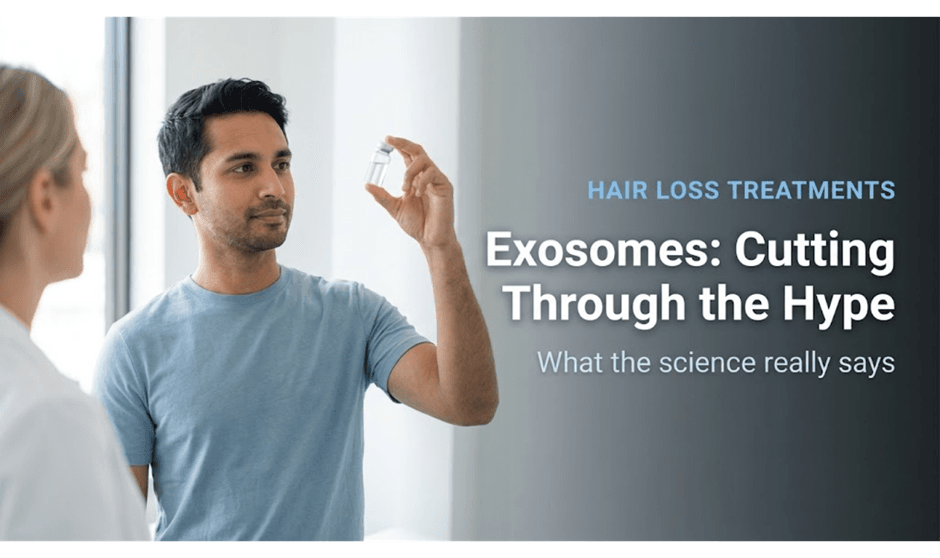
Spend ten minutes researching hair loss online and you’ll trip over the word “exosomes” sooner or later. Usually right next to a phrase like “the future of regrowth.” So is it? Kind of. Maybe. The science is real, the hype is a lot louder than the science, and the truth sits somewhere in the messy middle. Let’s get into it.
Okay, what’s an exosome?
Think of your cells texting each other. Exosomes are basically the texts. Tiny vesicles your cells release, loaded with growth factors, proteins and little bits of genetic code, all of it meant to tell nearby cells what to do.
For hair, the ones doctors care about usually come from stem cells. The pitch is simple enough. Get those signals into the scalp and they might poke tired or sleeping follicles awake, push more blood toward them, and quiet down the low-grade inflammation that tends to hang around weak ones.
You’re not adding hair. You’re trying to switch the factory back on. Clever, when you think about it.
Does it actually work, though?
This is the bit where I have to be straight with you. In a dish and in animal studies, exosomes look great. They get the dermal papilla, the tiny engine room at the base of each follicle, firing again. The handful of small human studies we have are encouraging too, with people seeing better density and feeling pretty good a few months in.
Small is the key word, though. A 2025 review that pulled all of it together said roughly what every careful review says about a young treatment. Looks promising. Not proven. More trials on the way. Translation: we’re early. Nobody has the big long-term data yet. So if a clinic is promising you a guarantee, they’re selling, not informing.
The bit nobody puts in the brochure
A couple of things that rarely make the sales pitch. Right now, no exosome product is FDA-approved for anything, hair loss very much included. The rules shift from one country to the next. There’s no agreed way to make or store the stuff, and where it comes from matters more than you’d think.
None of that makes it a con. It makes it new. And new means doing a bit of homework you wouldn’t bother with for a treatment that’s been around for thirty years.
So if you’re tempted
Slow down before you book anything. Ask questions. A few clinics now offer Advanced Exosomes as one piece of a bigger hair plan, usually sitting next to the more established options. It’s completely fair to ask where the exosomes come from, what evidence they’re going on, and what a realistic result actually looks like for someone in your situation.
One more thing, and it’s the big one. Get diagnosed first. Exosomes won’t touch some kinds of hair loss, and chasing a treatment before you know what’s wrong is backwards. A proper consult somewhere like Kibo Clinics can work out whether you’re dealing with pattern thinning, a temporary trigger, or something else entirely, and whether a regenerative route even makes sense for you.
Bottom line
Exosome therapy is one of those things where the science is real and interesting, and the marketing has sprinted way out ahead of it. Curious? Fine. Ask hard questions, keep your expectations on a short leash, and treat it as something still being figured out rather than a sure thing. And the usual reminder: this is general info, not medical advice. Let a real professional look at your actual scalp before you spend a rupee.
